Non-Halal Funds
Non-Halal Funds
Couldn't load pickup availability

Where Should Interest (Riba) Wealth Be Distributed?
Contemporary scholars agree that bank interest constitutes riba (usury), which is unlawful (haram). Therefore, it may not be used for personal benefit or for one’s family, such as for food, clothing, housing, or to pay utility bills (electricity, telephone, water), taxes, and so on.
Anything that is unlawful is, in essence, not considered one’s rightful property and may not be owned. In fact, it must be distributed and given away for charitable and public welfare projects.
(See: Fatawa of Sheikh Abdullah bin Baz; Al-Muntaqa Min Fatawa of Sheikh Salih al-Fawzan, Vol. IV, pp. 137–138, No. 141; Fatawa Mu‘asirah by Dr. Yusuf al-Qaradawi, Vol. 2, pp. 410–411.)
In the DSN-MUI Fatwa No. 123/DSN-MUI/XV/2018 concerning the Use of Funds That May Not Be Recognized as Income for Islamic Financial Institutions, Islamic Business Entities, and Islamic Economic Institutions, such funds must be used and distributed directly for the benefit of the Muslim community and the public interest, provided that it does not contradict Sharia principles.
Where Should Riba Wealth Be Distributed?
Scholars hold the following opinions on this matter:
-
It should be distributed for the general welfare of Muslims, not restricted to specific individuals or specific places. This is the opinion of Shaykh al-Islam Ibn Taymiyyah.
-
It should be given as voluntary charity (sadaqah sunnah) in general, covering beneficial causes such as assistance to the poor and needy or for mosque construction. This is the opinion of the Hanafi and Maliki schools, a view reported from Imam Ahmad (Hanbali), and also the opinion of Imam al-Ghazali among the Shafi‘i scholars.
-
It should be distributed for the welfare of Muslims and the poor, but not for mosque construction. This is the opinion of the scholars of the Permanent Committee (Lajnah Ad-Daimah) of the Kingdom of Saudi Arabia. They state that such wealth should not be used for mosque construction because mosque funds must come from pure (lawful) wealth.
Additionally, it should be noted that allowing bank interest to remain with the bank—so that it benefits the bank—is not permitted. This is based on the conclusions of Islamic research institutions and the resolution of the 2nd Islamic Bank Conference in Kuwait, because doing so would strengthen the bank’s position in engaging in riba-based transactions. This falls under the category of assisting in sin or unlawful matters. Assisting in sin or unlawful matters is itself unlawful.
(Fatawa Mu‘asirah, Dr. Yusuf al-Qaradawi, Vol. 2, p. 410.)
Rather, one should take it and use it for charitable and public welfare projects as explained above.
And Allah knows best.
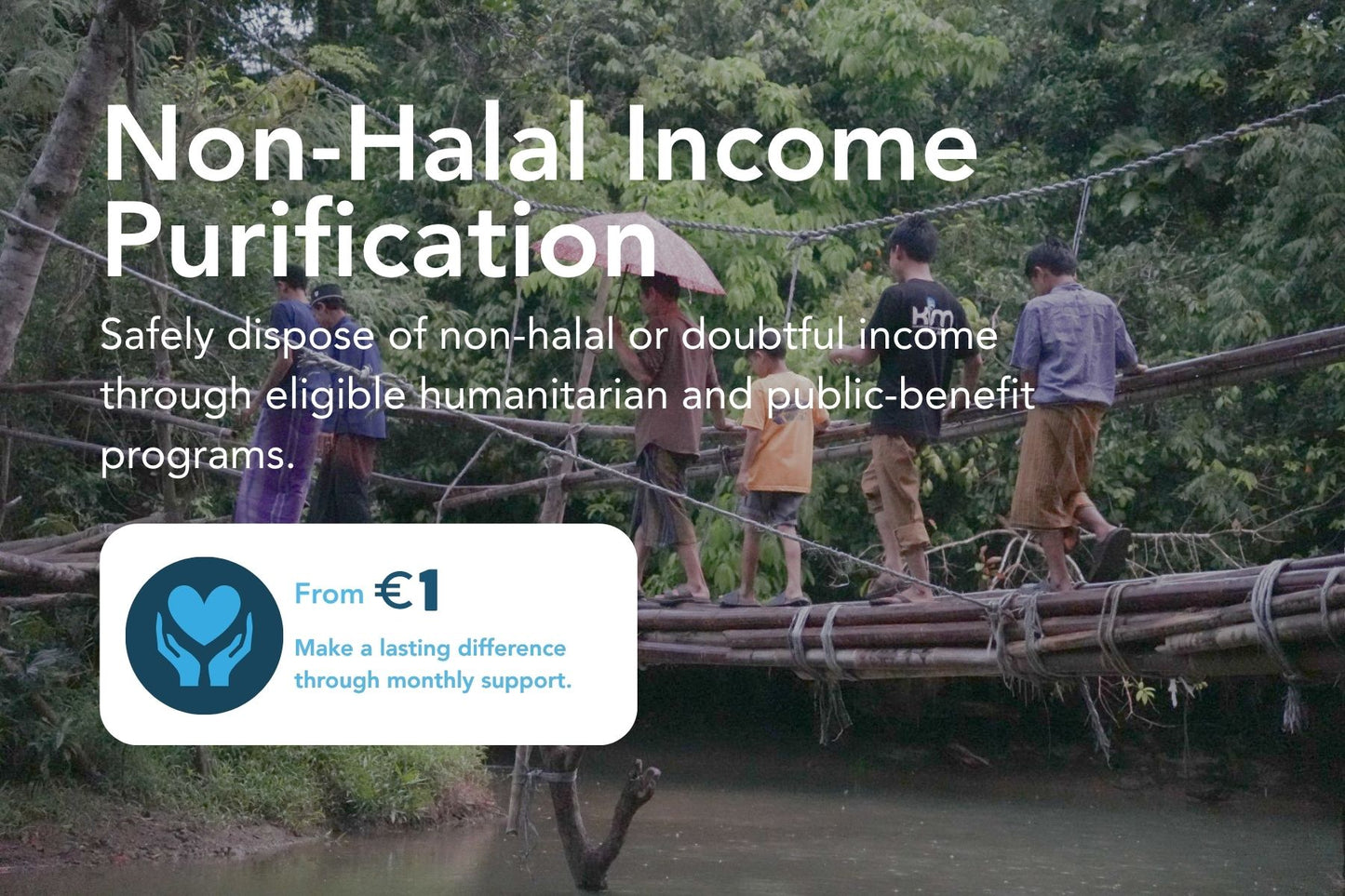
Human Initiative Europe accepts donations from non-halal funds contributed by the public, which are then used for the construction of public facilities such as bridges, roads, and sanitation facilities (public toilets).